https://archive.org/details/georgeblood
Reviewed by Matt Testa, audiovisual archivist [PDF Full Text]
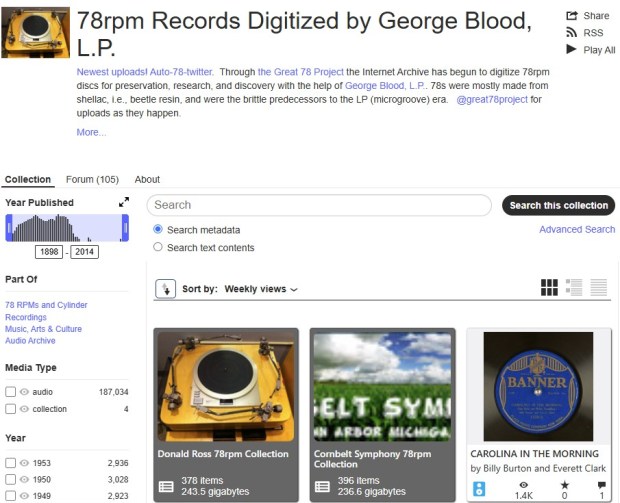
Figure 1. Collection homepage of the Great 78 Project on Internet Archive, https://archive.org/details/georgeblood
Internet Archive’s Great 78 Project aims to preserve a wide-ranging collection of 78 rpm records and other sound recording formats from the early twentieth century. As with other forms of physical media in its vast collections, Internet Archive acquires donated records, digitizes the content for preservation, and provides online public access. As of June 2026, more than 187,000 digitized record sides are available. Internet Archive is preserving both the physical discs and the digital files.
The Great 78 Project’s online collection is of enormous value to anyone interested in the sounds of the early twentieth century. Many 78 rpm recordings are not available on commercial streaming services or in other physical formats such as CD. Other archival streaming collections, such as the National Jukebox by the Library of Congress, offer a more limited range of material by label or subject.[1] Access to the physical items is beyond the reach of many users. Additionally, the shellac discs themselves are often extremely brittle, hard to find, and in need of careful cleaning and proper equipment for playback. The digital files allow users to hear a faithful reproduction of the original disc and view its label without having to enter a library or handle a fragile item.
The breadth of content in the Great 78 collection is truly impressive. Noteworthy are some subcollections of donations by the ARChive of Contemporary Music, the Boston Public Library, and several individual collectors with specialized interests such as polka or tango music.[2] The bulk of the Great 78 collection consists of musical recordings from about 1910 to 1950, especially popular songs, dance tunes, jazz, and classical, as well as some spoken-word recordings and sound effects. The project has prioritized digitizing “discs that are less likely to be commercially available—or available at all in digital form—particularly focusing on underrepresented artists and genres.”[3] Included are rare recordings of ragtime, blues, gospel, early country music (sold as “hillbilly” music), and Hawaiian music. Dozens of languages are represented in the collection.
The project prioritizes the preservation of rare recordings ahead of their discoverability, so the item descriptions are sometimes not as robust as they could be, especially when compared to digital audio collections of other major libraries. The item-level descriptive metadata typically contains basic details transcribed from the disc label by a digitization engineer, and possibly one or more subjects to describe the genre and source recording format. Subject headings and creator names may be inconsistent due to a lack of authority control. Librarians and other volunteers have augmented some metadata records, and users are invited to contribute additional information through item reviews (Figure 2).
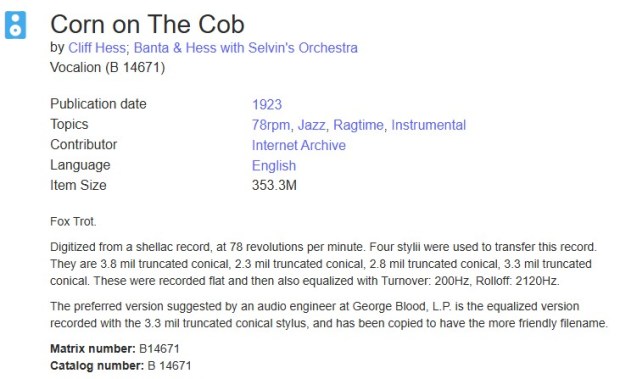
Figure 2. Example of basic metadata for an item in the Great 78 collection, https://archive.org/details/78_corn-on-the-cob_cliff-hess-banta–hess-with-selvins-orchestra_gbia0000417b. Additional technical metadata provided for the item is not shown in the screenshot.
Users can search within the collection by keyword or run an advanced search. The facets by subject, creator, and language can narrow results, particularly for users who are just browsing (Figure 3). Internet Archive does not provide reference support to help individuals locate particular recordings, but it hosts a community messaging board where users can ask for help.
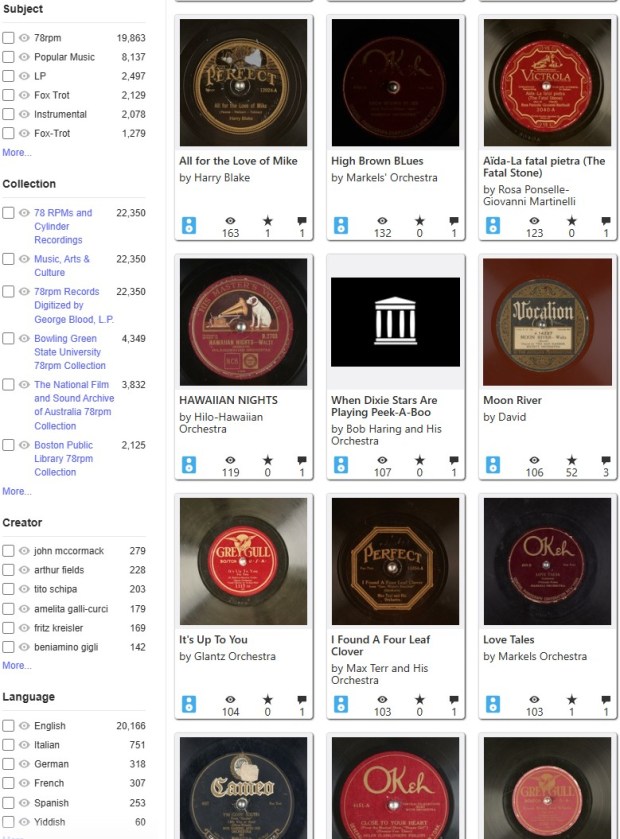
Figure 3. Faceted search sidebar and search results
Another strength of the collection, particularly for those interested in recording technology history and audio restoration, is in the variety of digital files provided for each recording. A single disc may be digitized using as many as four different styli, with or without equalization, resulting in several audio files. The engineer chooses what they think is the best version to be available for streaming on the website. All versions can be downloaded as high-quality lossless FLAC files. Spectrogram files are also provided so users can graphically compare one version to another. The audio files are “flat” transfers without any noise reduction or other restoration. These may sound particularly scratchy to modern ears, but the raw recordings hold research value that distinguish them from commercial products.
Unfortunately, however, the distinction between research access and commercial use was not appreciated by major record labels, who sued Internet Archive for $700 million for alleged copyright infringement associated with the Great 78 Project. The legal dispute was settled in September 2025, but it resulted in more than 200,000 recordings—and apparently all of the metadata associated with those items—being taken down from the public collection.[4] As of this writing, no new items have been added since 2024. Users may encounter some dead links within the site, such as when an item points to the reverse side of a record that has been taken down.
Despite the reduction in content, the Great 78 collection continues to offer a wealth of recorded sounds not found anywhere else. Music lovers can discover forgotten songs, cultural historians can analyze vaudeville comedy routines, and audio engineers can experiment with noise-removal methods on the unrestored transfers. I have heard early jazz recordings from the collection on my local community radio station and on a podcast by a 78 collector. The use possibilities are endless for anyone with ears and an internet connection.
[1] “About this Collection: The National Jukebox,” Library of Congress, https://www.loc.gov/collections/national-jukebox/about-this-collection/.
[2] “The Great 78 Project: About Collections,” Internet Archive, https://great78.archive.org/about/.
[3] “78rpm Records Digitized by George Blood, L.P.: About,” Internet Archive, accessed June 22, 2026, https://archive.org/details/georgeblood?tab=about.
[4] Ashley Belanger, “Internet Archive’s Big Battle with Music Publishers Ends in Settlement,” Ars Technica, September 15, 2025, https://arstechnica.com/tech-policy/2025/09/internet-archives-big-battle-with-music-publishers-ends-in-settlement/; Jon Blistein, “Internet Archive and Major Labels Settle $621 Million Copyright Lawsuit, ” Rolling Stone, September 15, 2025, https://www.rollingstone.com/music/music-news/internet-archive-labels-settle-great-78-copyright-lawsuit-1235427887/.

