https://www.springshare.com/libguides
Reviewed by Diana Dulek, Metadata Librarian, University of Houston Law Library [PDF Full Text]
Most librarians already know what a LibGuide is. On the homepage for LibGuides, its developer, Springshare, calls LibGuides “the most popular content management & curation platform for libraries.”[1] In this review, however, I want to explore how LibGuides, similar to Omeka, can and are being used as online exhibits.
For context, I am the metadata librarian in a small academic law library. In my library, we have approximately two archival collections. One of those collections, the Judge Brown Collection, suffered damage during one of Houston’s many tropical storms. Judge John Brown was a judge on the Fifth Circuit Court of Appeals during the civil rights movement, as well as an authority on admiralty law. After the storm, it was important to restore research access to his papers. The library eventually secured funds to digitize the collection so users could once again safely research the records. Once digitized, we wanted to create an online exhibit to provide context about the collection and let patrons know how to access it. Given the small size of our archives and our team, the move that made the most sense financially and in terms of staffing was to use something for which we already had the infrastructure.
My library director suggested a LibGuide for the exhibit. I had never used LibGuides in this way, so I wanted to see some examples to get a sense of what an exhibit would look like. Thankfully, when you set out to create a new LibGuide, you have the option to “start fresh” or “copy content/layout from an existing guide.” If you choose the latter, the software will let you copy content and layout from either a local guide or a community guide that is set up for sharing, assuming you have obtained permissions to do this.[2] A community guide, as you might guess from the name, is a guide made publicly searchable to the LibGuides community by a LibGuides user from another institution.
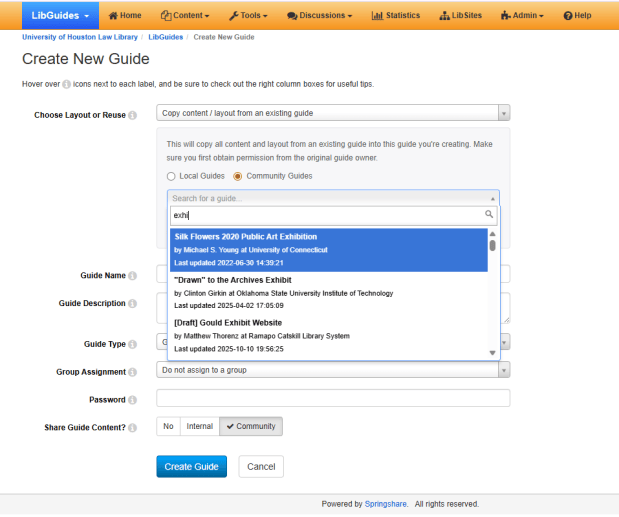
Figure 1. Screenshot of Create New Guide page, with option to choose layout from Community Guides highlighted
To look for examples of other institutions that used LibGuides to create online exhibits, I looked at the community guides that had the word “exhibit” in the name, and then separately looked up those libraries online to view the LibGuide on the library’s website. Most libraries that use LibGuides in this way are smaller institutions, who feature one-off projects or small annual exhibits.[3] The people making the LibGuides were not necessarily archivists or dedicated special collections staff. In other words, they were people like me at libraries like mine.
Some of the exhibit pages were merely placeholders to advertise a collection and get patrons to visit the library and view the collection. Others were more traditional, featuring photographs of items with detailed descriptions. The layout of the guide can be tailored to however you want to present your exhibit or page.
For our LibGuide, we chose to have a page dedicated to the history of the collection itself, a page about the judge whose papers make up the collection, and a page on how to access the collection. The access page includes an embedded LibWizard form that allows people to request the content they are interested in so that the library can prepare those files before getting in touch with the researcher.[4]
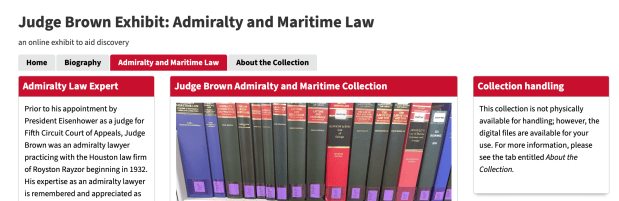
Figure 2. The Judge Brown Exhibit: Admiralty and Maritime Law page
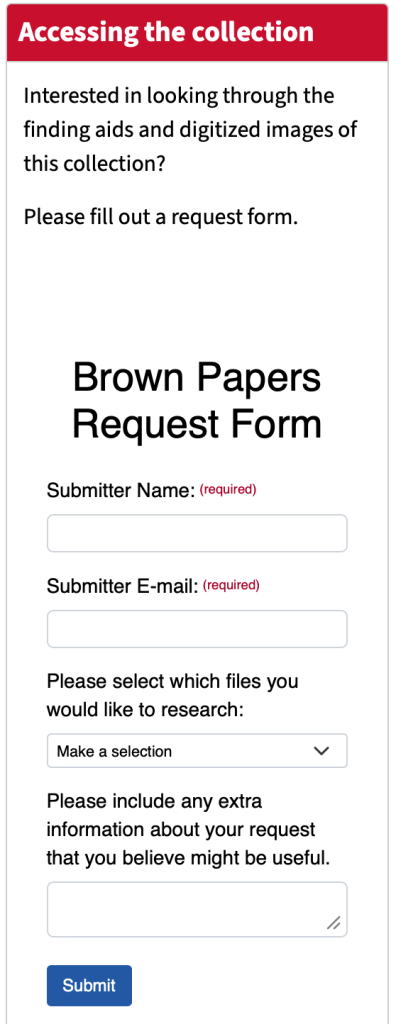
Figure 3. The Judge Brown Collection online request form
I presented this project at the poster session for the American Library Association’s Core Forum, and I could tell reviews were mixed. Some people seemed skeptical of the nontraditional workflow and tools. I explained that our library wanted to maintain stewardship of this collection but does not have enough archival collections to merit investing in a large digital asset management system and digital library. I understand that a LibGuide doesn’t have the curb appeal of more well-known software specifically made for exhibit access, like Omeka[5] or Preservica.[6]
But the people working in small libraries with small teams, who found themselves with the odd box of archival items they wanted to let people know they had—that’s who spent the most time at my poster presentation. Ultimately, I think that’s who this workaround can really benefit. A lot of smaller organizations may not have robust digital libraries or a strong digital preservation program, but many will have a LibGuides subscription. LibGuides is very plug-and-play, and it’s something you can purchase without needing to purchase the entire Springshare suite of products. Moreover, while Springshare is responsive to emails, the LibGuides user community is well established and has lots of helpful documentation.
Throughout the process of putting together the LibGuide and LibWizard form, I did worry about not measuring up. I felt like I might be missing something by not using software specifically marketed to my purpose. But our LibGuide was able to help us meet our needs on a platform that our patrons and staff were already familiar with.
[1] Springshare, “LibGuides,” accessed April 26, 2026, https://www.springshare.com/libguides.
[2] LibGuides suggest contacting the creator of the guide for their permission to use their layout and/or content.
[3] An example is the “‘Drawn’ to the Archives Exhibit” at the Oklahoma State University Institute of Technology (OSUIT): https://library.osuit.edu/scitartists. OSUIT has about 3,000 undergraduates.
[4] See University of Houston Law Library, “Judge Brown Exhibit,” https://law-uh.libguides.com/judgebrown.
[5] For an overview of Omeka, see Selena Chau, “Technology Roundup: Free and Low-Cost Online Exhibit Platforms,” American Archivist Reviews Portal, August 6, 2025, https://reviews.americanarchivist.org/2025/08/06/technology-roundup-free-and-low-cost-online-exhibit-platforms/.
[6] For an overview of Preservica, see Rose Buchanan and Stephanie Luke, “Preservica,” American Archivist Reviews Portal, May 5, 2022, https://reviews.americanarchivist.org/2022/05/05/preservica/.

