https://www.accesstomemory.org
Reviewed by Nancy L. Webster, archives director, Highland Park Historical Society, and adjunct professor, Dominican University [PDF Full Text]
Access to Memory (AtoM) is a “web-based, open source application for standards-based archival description and access in a multilingual, multi-repository environment” (https://www.accesstomemory.org/en/). AtoM is open-source and free. The International Council on Archives supported AtoM’s initial development, envisioning improved access to archives in accordance with descriptive standards and archival practices. Launched in 2005, AtoM continues to be developed by Artefactual, an original partner. Since 2018, the Access to Memory Foundation provides governance and endeavors “to oversee and support the development, sustainability and adoption of Access to Memory (AtoM) as a multilingual, multi-repository open source application for standards-based archival description and access” (https://accesstomemoryfoundation.org/).
AtoM’s structure mirrors standard levels of description at depository, collection, series and fonds, sub-series and folder, and item levels. Its structure permits researchers to retrieve descriptive information at any level while clearly displaying creation and other archival contexts. Archivists may select appropriate descriptive and authority standards. The 2.7 version includes DACS, RAD, MODS, DublinCore, and ISAD. Pop-up rules for each element in the selected standard provide ready reference when necessary. This flexibility permits parallel descriptions within individual collections and extra-AtoM interchanges via API or incorporating International Image Interoperability Framework (IIIF). IIIF enables file portability and viewing, facilitating connections and discovery. AtoM is positioned for transitions to Records in Context (RiC); however, archival descriptions may evolve before this transition occurs.
I adopted AtoM in 2012 after using both the Archivists’ Toolkit and Archon to implement a basic processing grant from the National Historical Publications and Records Commission. This decision predated the ArchivesSpace 2013 launch. I have seen AtoM evolve with archival descriptive standards and metadata exchanges, including for digital collections. Developer Artefactual works with users to implement changes and updated versions. An online community and user group meetings provide professional support and interaction. These international groups also discuss archival issues such as authorities and digital content management.
Benefits for the Archivist
AtoM’s multi-depository and multilingual environment provides opportunities for collaboration and increased access. Descriptions may be imported, edited, and exported using Encoded Archival Description (EAD) and Dublin Core using open-source tools like Notepad++. AtoM provides a public export link for Dublin Core and EAD.
Batch and individual imports can be created with XML and CSV spreadsheets. Eight categories, including archival descriptions, authorities, and digital objects, are available on the AtoM Wiki: https://wiki.accesstomemory.org/wiki/Main_Page. Additionally, AtoM community members can share resources and suggestions with each other.
As with many archives description programs, multiple methods exist to enter and edit a record directly into AtoM. For example, users can add “siblings and children” within the main record (Figure 1).

Figure 1. Adding new child levels in AtoM
Alternatively, users can choose to add or edit a record using the menu at the bottom of each record page (Figure 2).

Figure 2. Editing menu at the bottom of a record page in AtoM
While AtoM endeavors to include necessary elements for describing archives, users with administrative privileges can adjust elements and other settings.
Users may add digital images to a collection or record via import or by linking digital objects to a record at any level. These features permit both bulk digital object imports and the addition of a digital object to an existing record.
Name authority records link to the related archival descriptions (Figure 3). Import and export capabilities are compatible with Encoded Archival Context-Corporate bodies, Persons, and Families (EAC-CPF). A drop-down menu matches typed input to the local authority list. If there is no match, a new authority record is created. New entries must be completed via authority records in the “Names” module.
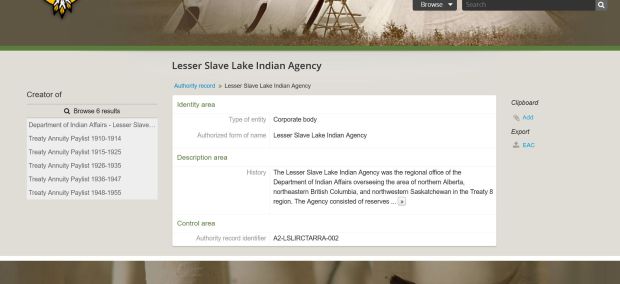
Figure 3. Lesser Slave Lake Indian Agency authority record, https://lslirc-tarrarchives.accesstomemory.org/lesser-slave-lake-indian-agency
AtoM also provides accession and donor records capabilities in separate tables linking to archival descriptions and authorities. The donor and accession tables are only viewable with a user log-in.
For the Researcher
Elasticsearch indexing and an enterprise search engine provides AtoM with reliable, robust capabilities. However, when a researcher arrives at an AtoM collection’s page—via organizational links or a Google search results list—they can navigate the public interface to complete descriptions, additional levels, and links.
The AtoM public interface provides descriptive information most immediate to researchers’ queries in the initial results list, including the title, date, and creator. Users may open and expand the links in the results list for more details (Figure 4).

Figure 4. The Mennonite Archival Information Database archival descriptions’ landing page, https://archives.mhsc.ca/index.php/informationobject/browse
AtoM also provides subject (controlled) browsing, which can help users find collections related to specific topics (Figure 5).
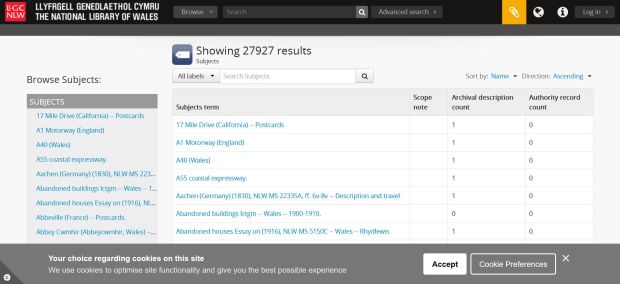
Figure 5. Archives and Manuscripts of The National Library of Wales Subjects page, https://archives.library.wales/index.php/taxonomy/index/id/35
Challenges
AtoM installation is complex and generally requires expertise with the open source Elasticsearch, Symfony PHP, and Qubit. Artefactual, LibraryHost, and Culturalhosting (Spain) offer services for institutions that do not have in-house technological support. This means that AtoM is not truly free.
Access to the command line for maintenance, bulk imports, error logs, and related root actions is based on the service selected. (Note: In the past, I have installed and managed Re:discovery, Archivists’ Toolkit, and Archon without assistance. My knowledge and skills are not sufficient to install or update AtoM.) Tasks that require access to the command line are rare, however, and are included in the hosting contract, although the number of changes users can request is based on subscription levels. For example, LibraryHost offers four levels from basic to premium with increased training, customization, and “advanced support” services at each level. Artefactual begins with a basic level that includes installation, performance and security optimization, new release upgrades, nightly geo-remote backup, data corruption recovery, a free SSL/TLS certificate, and dedicated email support.
AtoM also does not support or export MARCXML. A crosswalk from EAD to MARCXML is necessary. Examples are available from the Library of Congress or metadata management tools such as MarcEdit.
Conclusion
AtoM benefits institutions of varying sizes. Its muti-depository functions permit collaboration and shared hosting for institutions related by geography, subject, or affiliations. It is an open-source web-based platform that conforms to international and national standards and metadata exchanges in multiple languages.
 The American Archivist Reviews Portal