https://docsouth.unc.edu/sohp/index.html
Reviewed by Bryan Mathison, Research Associate II, National Strategic Planning & Analysis Research Center, Mississippi State University [PDF Full Text]
Background
As a research associate, I have ample opportunity to seek out and utilize primary sources. As a doctoral student, I fully appreciate how important it is to have access to primary source materials because they are the backbone of research. I recently came across the University of North Carolina at Chapel Hill’s Oral Histories of the American South. In this review, I share my experience with the collection.
The Oral Histories of the American South started during the mid-1990s. Specifically, the program began as an effort to digitize a collection of narratives from formerly enslaved peoples. This occurred at a time when there was limited access to the internet. In describing the goal of the project, the creators note that they “sought to present oral histories in a way that would allow users to locate relevant interview segments as well as review entire interviews” (https://docsouth.unc.edu/sohp/about/about.html). The earliest version of this program was available to the public in 2005. Since 2005, the Oral Histories of the American South has expanded to include 500 interviews. This project was granted funding, and funding ended in 2008. Since then, there does not seem to have been any substantial updates to the site.
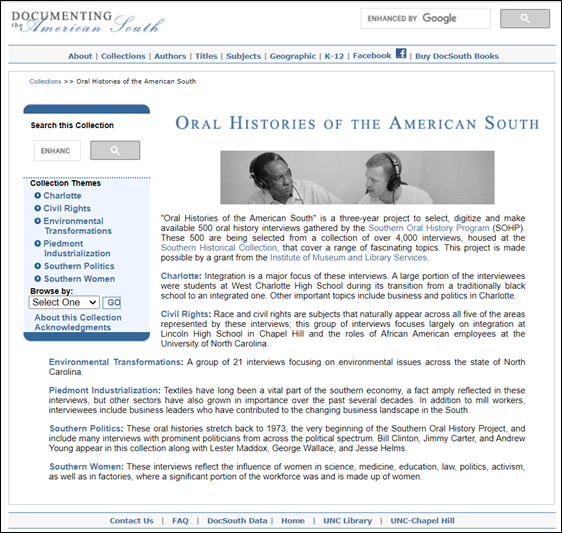
Figure 1: The Oral Histories of the American South’s landing page, accessible at https://docsouth.unc.edu/sohp/
Structure
The collection’s landing page is text heavy but not overwhelming. The interviews are organized thematically around clusters, including “Charlotte,” “Civil Rights,” “Environmental Transformations,” “Piedmont Industrialization,” “Southern Politics,” and “Southern Women.” Organizing the collection around clusters makes it easier for users to locate interviews that best align with their research topics. For example, political science and public administration scholars may be interested in former Alabama governor James Folsom’s interview from December 1974. Public administration scholars could use Folsom’s discussion of various federal agencies and hiring to study ethics as well as organizational culture. Political science students would benefit from Folsom’s discussion of the various campaigns that he ran.[1] Political journalist Ferrel Guillory’s interview also provides insight on the development of two-party politics that political scientists would find helpful.[2]
Users have multiple search options. On the landing page, they can use the “Browse by” drop-down menu to browse interviews by date, interviewees, interviewers, and other characteristics. Selecting an option in this menu takes users to a list of related interviews. Users then have the option to navigate the list via linked headings. For example, researchers who opt to browse by dates will be given a chronologically organized list of interviews that they can navigate by decade (see Figure 2). The lists are well structured. Users will appreciate the attention to detail and clarity as they browse the collection. Most interviews also include a short abstract, which makes it easier for researchers to understand the scope of the content.
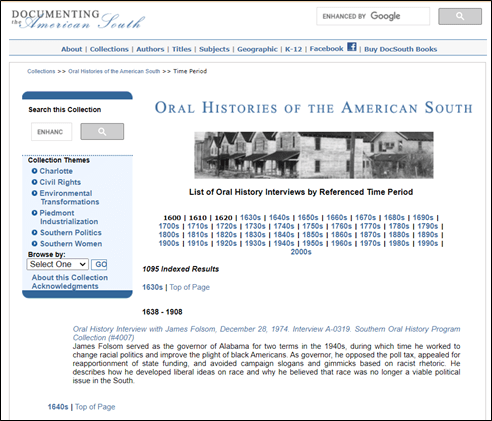
Figure 2: Browse by dates, accessible at https://docsouth.unc.edu/sohp/browse/dates.html#gsc.tab=0
Alternatively, users also have the ability to use the “Search this Collection” feature. Users can type in search words and be provided with links to related materials. While this feature may appeal to some, it is not for all. The “Search this Collection” feature is not aesthetically appealing or as efficient as more modern search options. In fairness, though, this feature was designed over a decade ago, so I understand why it doesn’t have the same level of functionality or design of modern search engines.
Accessibility
Each interview includes a written transcription and an audio file. Users are also given the option to listen to the audio with the transcription on screen, and they can download MP3 files for many interviews, which is a great feature. Providing access to both transcriptions and audio files makes using the Oral Histories of the American South collection easier and more convenient than some other oral history resources. When using oral history materials, I sometimes switch between the audio files and the transcriptions, so having both accessible simultaneously is helpful. The robust content and ease of accessibility makes this collection especially interesting for qualitative scholars.
There are many other benefits to providing multiple accessibility functions. Providing access in multiple forms, for instance, makes the materials easier to use for those who may have hearing or visual challenges.
Drawbacks
In terms of drawbacks, there are a few. Sometimes, finding a certain line in a transcription can take a little practice. The search function can also take some getting used to. As noted above, the search function is dated, so users unfamiliar with older websites may struggle at first. The process of finding materials in the Oral Histories of the American South collection is otherwise simple and straightforward.
The audio quality is generally good, although some interviews have very minor sound distortions. These distortions may stand out to users who are unfamiliar with older audio recordings, but they are overall a small inconvenience. Given the age of some of the interviews, the audio quality is actually quite good.
Finally, while the oral history collection includes interviews from a wide range of states, the collection is heavily geared toward experiences of North Carolinians. This is not unexpected, since this project was produced by the University of North Carolina at Chapel Hill. That being said, if the project was to represent the whole of the American South, it would be nice to see more insights from across the region.
Conclusion
In closing, the Oral Histories of the American South collection is an outstanding resource for researchers studying the American South or American history. Scholars in fields such as political science, public administration, and others will also find the collection helpful. The cluster structure and accessibility features are functional and generally straightforward. While the range of interviews can be limited, the collection represents a strong resource that researchers, students, and others are sure to appreciate.
[1] “Oral History Interview with James Folsom, December 28, 1974. Interview A-0319. Southern Oral History Program Collection (#4007),” Oral Histories of the American South, https://docsouth.unc.edu/sohp/A-0319/menu.html (accessed May 25, 2024).
[2] “Oral History Interview with Ferrel Guillory, December 11, 1973. Interview A-0123. Southern Oral History Program Collection (#4007),” Oral Histories of the American South, https://docsouth.unc.edu/sohp/A-0123/menu.html (accessed May 25, 2024).
 The American Archivist Reviews Portal