https://inclusivehistorian.com
Reviewed by Mattie Clear, Instruction and Outreach Archivist and Assistant Professor, Washington and Lee University Library Special Collections and Archives, Lexington, VA [PDF Full Text]
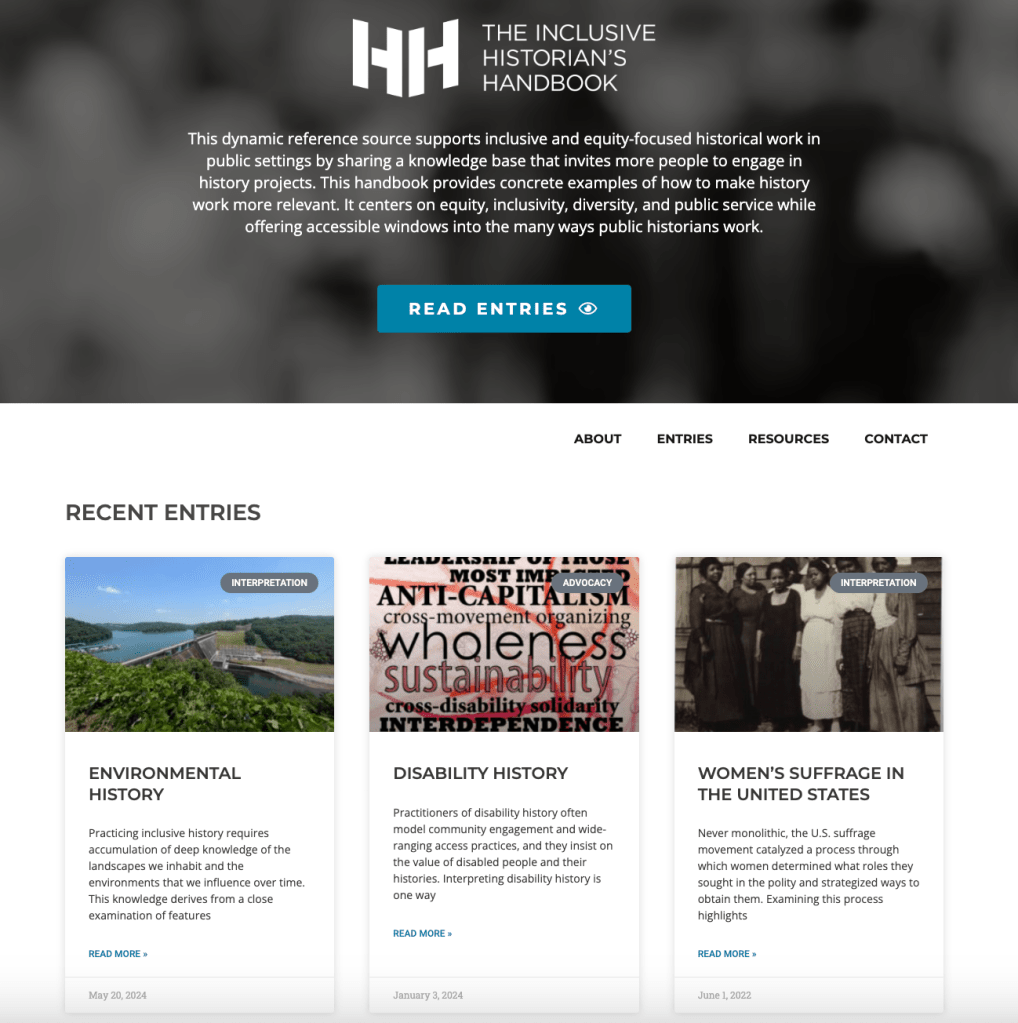
Figure 1. Screenshot of the homepage of The Inclusive Historian’s Handbook, https://inclusivehistorian.com/
The Inclusive Historian’s Handbook is a resource sponsored by both the American Association for State and Local History (AASLH) and the National Council on Public History (NCPH) to further their mutual goal of supporting the public history community through the creation and promotion of resources related to historic interpretation. The Handbook’s stated goal is to make diversity, equity, and inclusion (DEI) resources more freely accessible to those engaging in history work. In addition to DEI, the project aims to create an accessible knowledge base for those working with history, offer examples from those in the field regarding how to make history more accessible, and provide a way for individuals to understand public historians’ work.[1] AASLH and NCPH began developing the Handbook in 2016 and published its first entries in 2019. However, the Handbook is a living document, with entries published on an ongoing basis.
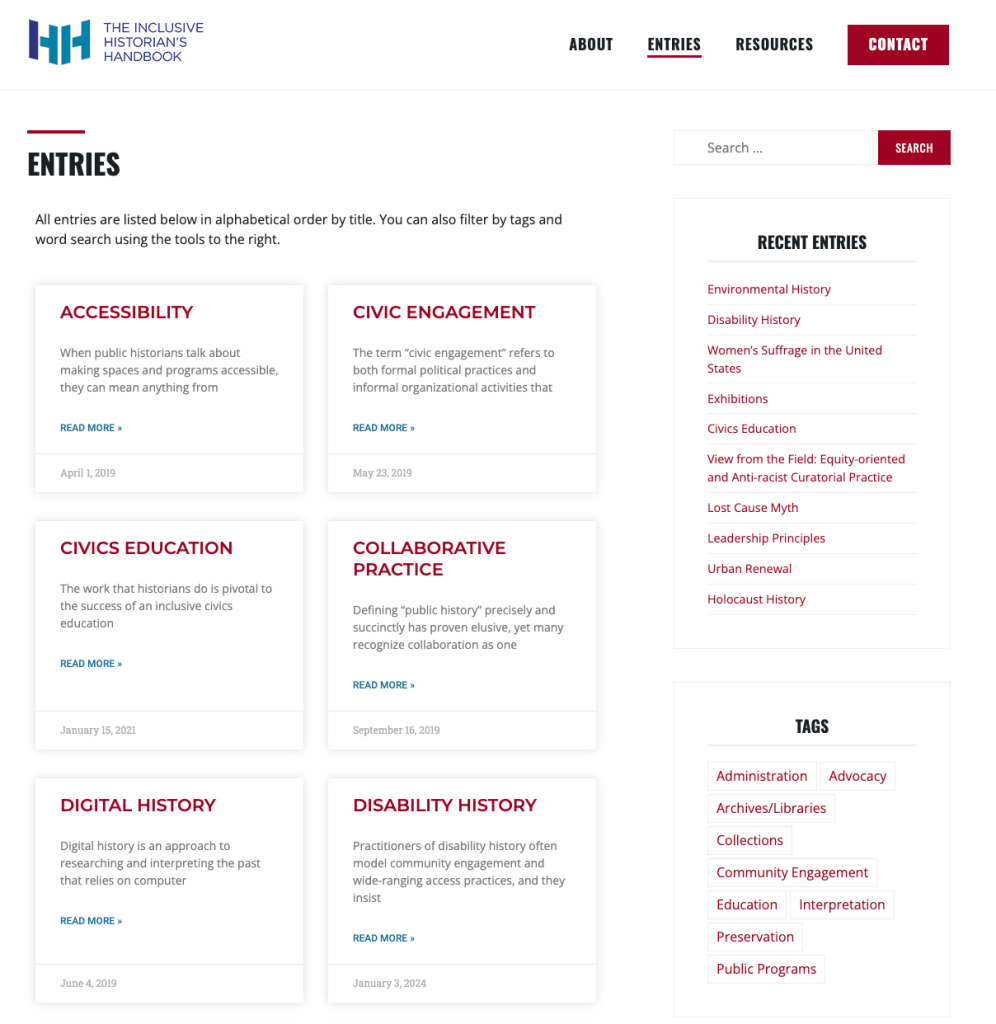
Figure 2. Screenshot of the Entries page in The Inclusive Historian’s Handbook, https://inclusivehistorian.com/entries/
The Handbook is composed of multiple essays called “entries”; there were thirty at the time of this review in April 2024. Users can navigate these resources on the Entries page by title or tag (e.g., archives/libraries, advocacy, community engagement). Each entry is authored by a different individual who is a recognized expert in their field; the Handbook provides a wide array of experiences and perspectives. Entries cover field-specific topics like exhibitions and historic preservation as well as historical topics like women’s suffrage and reconstruction. Each entry begins with an introduction followed by interpretations and real-world examples and concludes with a list of suggested resources on the topic.
While engaging with this resource, I was thoroughly impressed with its accessibility and willingness to address what have historically been challenging topics for those engaged in all aspects of cultural heritage, including museum and archival professionals. I found the site and resources intuitive to navigate and was pleased by the number of resources explicitly related to archives and libraries, which are easily accessible from the Entries page via a tag. I was specifically drawn to “View from the Field: Equity-Oriented and Anti-Racist Curatorial Practice” and the “Lost Cause Myth,” as I think about both topics often in my current position.[2]

Figure 3. Screenshot of the entry homepage of “View from the Field: Equity-Oriented and Anti-Racist Curatorial Practice” in The Inclusive Historian’s Handbook, https://inclusivehistorian.com/view-from-the-field-equity-oriented-and-anti-racist-curatorial-practice/
The first of these entries, “View from the Field,” describes antiracist curatorial practices in the museum field while also providing concrete examples of this work and considerations when engaging with this work. While this entry specifically focuses on museums and their nuanced practices, the placement of DEI at the core of all collecting and interpretation is one that the archives profession continues to grapple with. Specifically, there are many parallels between the “Museums Are Not Neutral”[3] movement, which this entry discusses, and the “Archives Are Not Neutral”[4] movement. As cultural heritage practitioners, we all engage with the idea that we as humans affect the description and subsequent importance placed on materials in our collections.
The second entry, “Lost Cause Myth,” engages with the history of this myth and its evolution over the last 125 years. Specifically, the entry explores how the pervasiveness of the Lost Cause myth continues to affect cultural heritage practitioners today and the associated scrutiny many face in the wake of implementing crucial changes. In recent years, archivists and other cultural heritage practitioners have come to accept and understand the need for redescription, as any descriptive work is a product of its time. This is particularly relevant for materials related to southern history that may have been created during the peak of the Lost Cause narrative and now warrant an updated description highlighting the voices of those historically silenced. In addition to description and contextualization of these items in our collections, it is also key to frame the importance of this work to users. This entry was particularly profound for me as an archivist working to recontextualize a collection steeped in a long history of Lost Cause ideology. The work of consciously updating and diversifying collections (be they in museums, archives, or libraries) is never easy, but it is always necessary and worth it.
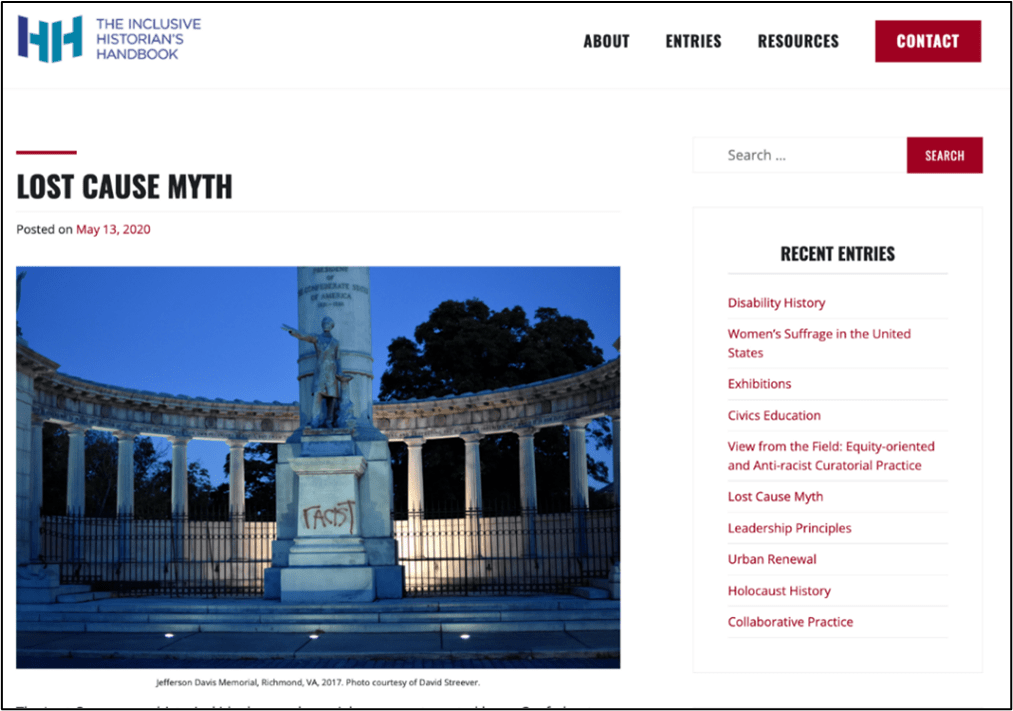
Figure 4. Screenshot of the “Lost Cause Myth” entry in The Inclusive Historian’s Handbook, https://inclusivehistorian.com/lost-cause-myth/
Both entries are very accessible in their language and examples, and they also provide concrete recommendations for moving forward with crucial DEI work by various cultural heritage practitioners regardless of experience or education level. While I was impressed with the Handbook, its one weakness lies in the accessibility of the suggested readings at the end of each entry. Many of these readings seem to be published by university presses or academic journals that are often behind paywalls that may be cost-prohibitive to smaller institutions or individuals not affiliated with an academic institution. I personally would have loved to see an open access designation for resources easily accessible to the reader to allow users to easily engage with free resources before pursuing resources that are behind a paywall.
The fact that the Handbook is freely accessible online allows for a plethora of opportunities to utilize it as a resource for students, early-career professionals, and professional development across all disciplines of public history. I can see the Handbook being particularly helpful for archivists as we think about our audiences and the people we engage in public programming every day. The entries currently tagged as “Archives/Libraries” relate to the presence of archival silences and the work that takes place when describing and making accessible historically marginalized and silenced voices. I have already shared these resources with my archives and museums peers to help them navigate these important questions and conversations at personal, professional, and institutional levels. The Handbook’s creators acknowledge that this work does not exist in a vacuum and so they reference the work of other public historians, including the Society of American Archivists.[5]
I look forward to continuing to engage with the Handbook as it grows and would encourage anyone interested in providing an entry to reach out to the creators. As we continue to grow and change as cultural heritage practitioners, we can work together on resources like the Handbook to achieve a shared goal of inclusivity and accessibility.
[1] “About The Inclusive Historian’s Handbook,” https://inclusivehistorian.com/about/ (accessed May 4, 2024).
[2] Elena Gonzales, “View from the Field: Equity-Oriented and Anti-Racist Curatorial Practice,” The Inclusive Historian’s Handbook, December 23, 2020, https://inclusivehistorian.com/view-from-the-field-equity-oriented-and-anti-racist-curatorial-practice/ (accessed May 4, 2024); Christopher A. Graham, “Lost Cause Myth,” The Inclusive Historian’s Handbook, May 13, 2020, https://inclusivehistorian.com/lost-cause-myth/ (accessed May 4, 2024).
[3] La Tanya Autry and Mike Murawski, “Museums Are Not Neutral: We Are Stronger Together” Panorama: Journal of the Association of Historians of American Art 5, no. 2 (Fall 2019), https://doi.org/10.24926/24716839.2277.
[4] Samantha Cross, “Archivists on the Issues: The Neutrality Lie and Archiving in the Now,” Issues and Advocacy Section of the Society of American Archivists Blog, March 27, 2017, https://issuesandadvocacy.wordpress.com/2017/03/27/archivists-on-the-issues-the-neutrality-lie-and-archiving-in-the-now/.
[5] “Key Resources,” The Inclusive Historian’s Handbook, https://inclusivehistorian.com/key-resources/ (accessed May 4, 2024).
 The American Archivist Reviews Portal