https://dictionary.archivists.org/
Reviewed by Gregory K. Tharp, MLS, Adv. Cert., MCAC [PDF Full Text]
In the ever-changing world of archives terminology, the Society of American Archivists’ (SAA) Dictionary of Archives Terminology (DAT) provides a resource to assist scholars, researchers, and archivists with understanding key concepts and terms that underpin archival work. As “North America’s oldest and largest national professional association dedicated to the needs and interests of archives and archivists,”[1] SAA is a credible organization to be producing a dictionary of archives terminology.
DAT can be seen as a controlled subject thesaurus for the archives field since it contains generally accepted definitions of standard archives terminology. DAT’s home page offers a basic search box in which users can enter a term. The box also has a dropdown menu with options for conducting an advanced search. These options include “Search in headword only,” “List all terms in category,” and “Search in full text of entry.” All ways to search DAT’s home page are intuitive and easy to use, making DAT a useful tool for archivists.
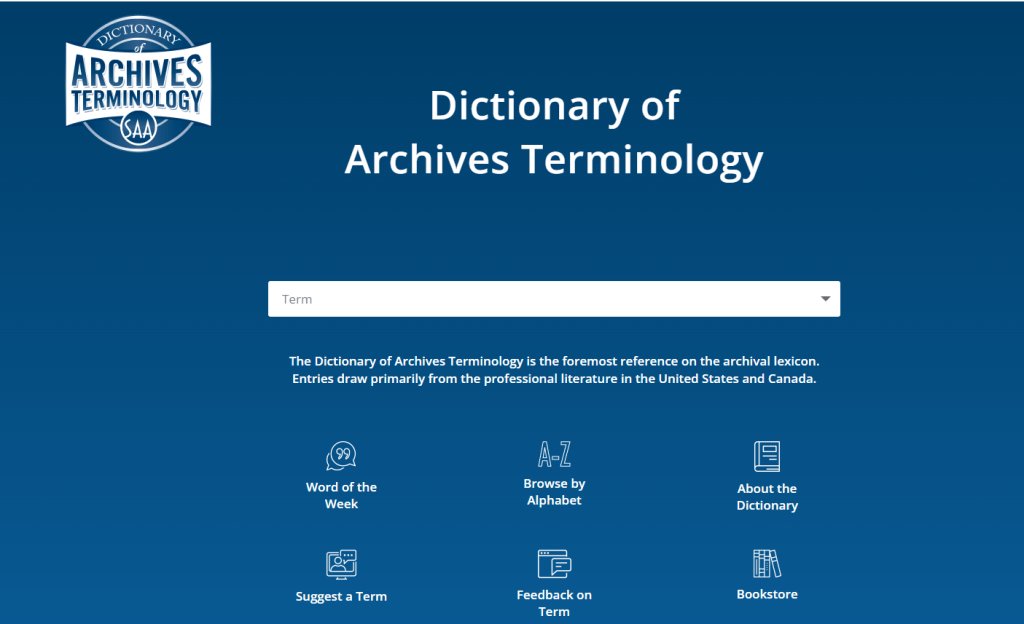
Figure 1. DAT home page
The About the Dictionary page, which is linked from DAT’s home page, provides useful tips for searching DAT. Each entry in DAT includes at least one definition of the term as well as a Notes section, which can include citations to sources that use the term and additional context. For example, DAT’s entry for added entry not only defines the term but also explains in the Notes section how added entries are entered into MARC fields. Broader terms, narrower terms, and related terms, when relevant, are linked to the left of the main entry.
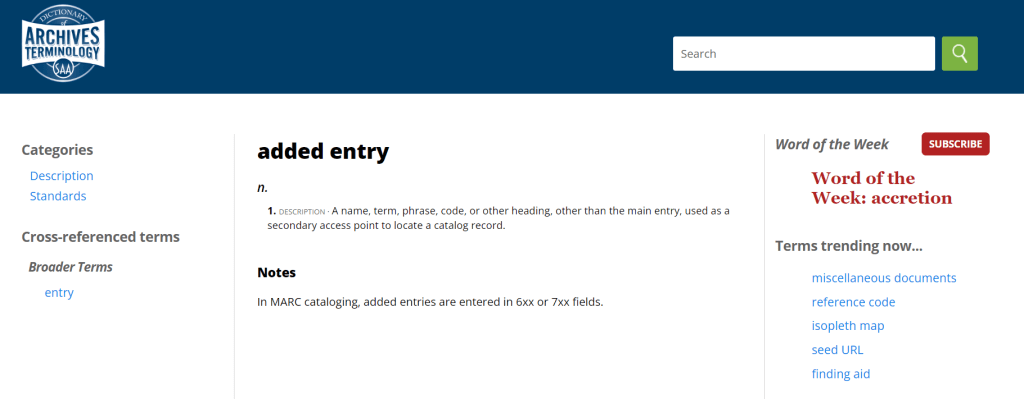
Figure 2. DAT entry for added entry
The Browse by Alphabet page, which is linked from DAT’s home page, allows users to browse the complete list of terms included in DAT. The terms are arranged alphabetically, and an A-to-Z horizontal listing at the top of the page allows users to navigate easily between different letters of the alphabet. On the right side of the page is a “Terms trending now…” section, which is another way for users to encounter terms in the dictionary.
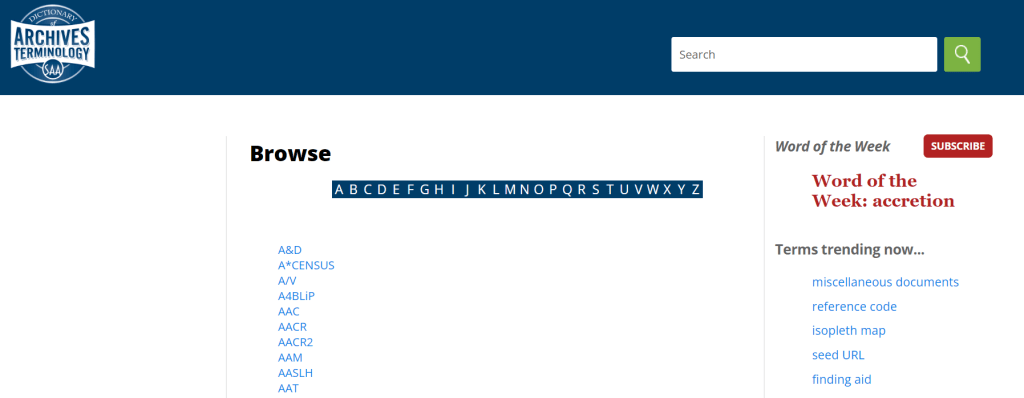
Figure 3. Browse by Alphabet page
DAT also offers a weekly Word of the Week that highlights new or revised terms. Users can access these terms through a link on DAT’s home page, through a page on SAA’s website, or by subscribing to a weekly email. The Word of the Week page on SAA’s website lists previously featured terms as well.[2]
Users have several opportunities to provide input on DAT. The Feedback on Term option, which is linked from DAT’s home page as well as the DAT page on SAA’s website, allows users to provide feedback on Word of the Week features. The Suggest a Term option, also linked from DAT’s home page and its page on SAA’s website, allows users to suggest a new term to be included in the dictionary. Both options encourage and foster professional dialogue around archives terminology.
The Bookstore link on DAT’s home page leads to SAA’s online store, where users can purchase SAA publications. Many publications build on terms featured in DAT and are a great way for users to expand their professional knowledge and development. One drawback of SAA’s Bookstore is that it is not organized by archival subject area, so users interested in a particular subject, such as government archives, may have difficulty finding content.
Overall, DAT is an extremely helpful resource for archivists, catalogers, and other information professionals who work with archival collections due to the breadth of archives terms that it includes. DAT is also useful for students, academics, and researchers who may not be familiar with archives terminology.
[1] Society of American Archivists, “About SAA,” https://www2.archivists.org/aboutsaa.
[2] Society of American Archivists, “Word of the Week,” https://www2.archivists.org/word-of-the-week.
 The American Archivist Reviews Portal